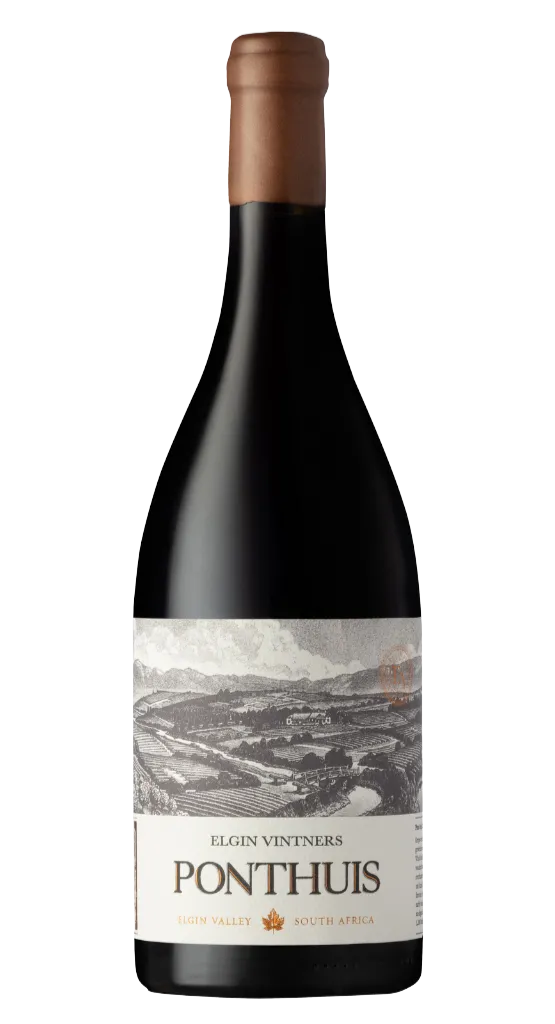
A complex and layered wine. Whole berry fermentation took place in large, open French oak vats using only indigenous yeasts from the vineyards. A slow, cool fermentation incorporating manual punchdowns has resulted in this superbly balanced wine. Wild, dark-berry fruits and a hint of raspberry intermingle with supple, well-rounded tannins offering a slightly earthy texture on the long-lingering finish. Naturally fermented and matured in Foudres, Vats and Barrels for 10 months prior to bottling.
100% Pinot Noir
W.O. Elgin
Elgin Vintners, established in 2003, farms 45 hectares of vineyards in the cool-climate Elgin Valley. Our main cultivars are Pinot Noir, Chardonnay and Sauvignon Blanc. In addition, we also have Merlot and Syrah. We practise sustainability in business, vineyards, and our people. As a result of this holistic approach, critics have awarded our wines top global accolades. Elgin Vintners crafts wines of exceptional poise, finesse, and elegance.
Elgin is South Africa’s coolest wine region. Cooler climates keep grape clusters connected to their roots for longer. Consequently, they develop more characteristics and achieve physiological ripeness more gradually with lower sugar levels and, therefore, lower alcohols. The resultant wines leave one with an impression of delicacy, but also power and insistence over warmer-climate examples, which show bolder but less persistent flavours.
Elgin vineyards sit at 305 m, the fourth highest in South Africa. The cold Atlantic lies close; this has a profound influence on day/night temperatures and prevailing south-easterly winds. At times, the South-Easter brings a cooling respite to the vineyards; however, it can also bring extensive cloud cover that becomes restricted by the surrounding mountains and extends back over the region. As a result, reduced sunlight lowers temperatures and slows the ripening of the grapes.
In more extreme cases, about four or five times yearly, the wind is strong enough and the clouds thick enough to enable precipitation known locally as a Black South-Easter. During these events, substantial rainfall can fall throughout the day. Conversely, on calmer, warmer days, cool coastal breezes move in from the sea as warm air over the land rises. As a result, temperatures drop quickly in the afternoon and into the night, helping maintain acid levels in the grapes. The grapes remain on the vine longer, which extends the ripening period and results in natural balance and complex, powerful flavours.
We tuck growing shoots between the wires frequently. Suckering is done twice during the growing season, in early November and January. After véraison, all small green bunches are removed. About four weeks before harvest, we strip bunch-zone leaves to achieve full phenolic ripeness
Upon receiving the fruit, we destem and do not crush the grapes, leaving 30% as whole bunches. Thereafter, natural fermentation takes place in open-top wooden fermenters without inoculation with commercial yeast. During the first half of fermentation, we pump over twice daily; however, we then reduce this to once a day to prevent over-extraction of tannins and phenolics. Fermentation lasted 18 days.
Seven days after fermentation, we began skin maceration. Once complete, we press the fully fermented wine to separate it from the skins and filled it into French oak barrels of 500 L, 300 L, and 225 L, of which 20% were new oak. Malolactic fermentation was completed in the barrel, followed by ten months of maturation prior to bottling.
Pinot Noir’s natural cherry and game characters pair wonderfully with the sweet and smoky flavours of barbecue. In particular, barbecued pork and skewers with bacon wrap will be highlighted by the corresponding flavours in Pinot Noir. You would also be surprised how well barbecued chicken goes with a glass of Pinot Noir. And to top it all, chocolate-covered strawberries will satisfy the taste buds.